
Your brand has published hundreds of perfectly optimized landing pages, and each one is built to rank for a specific query, without a single writer touching most of them. Sounds like a dream, right? Well, it is not, because this strategy, known as programmatic SEO that major companies are using to dominate search results.
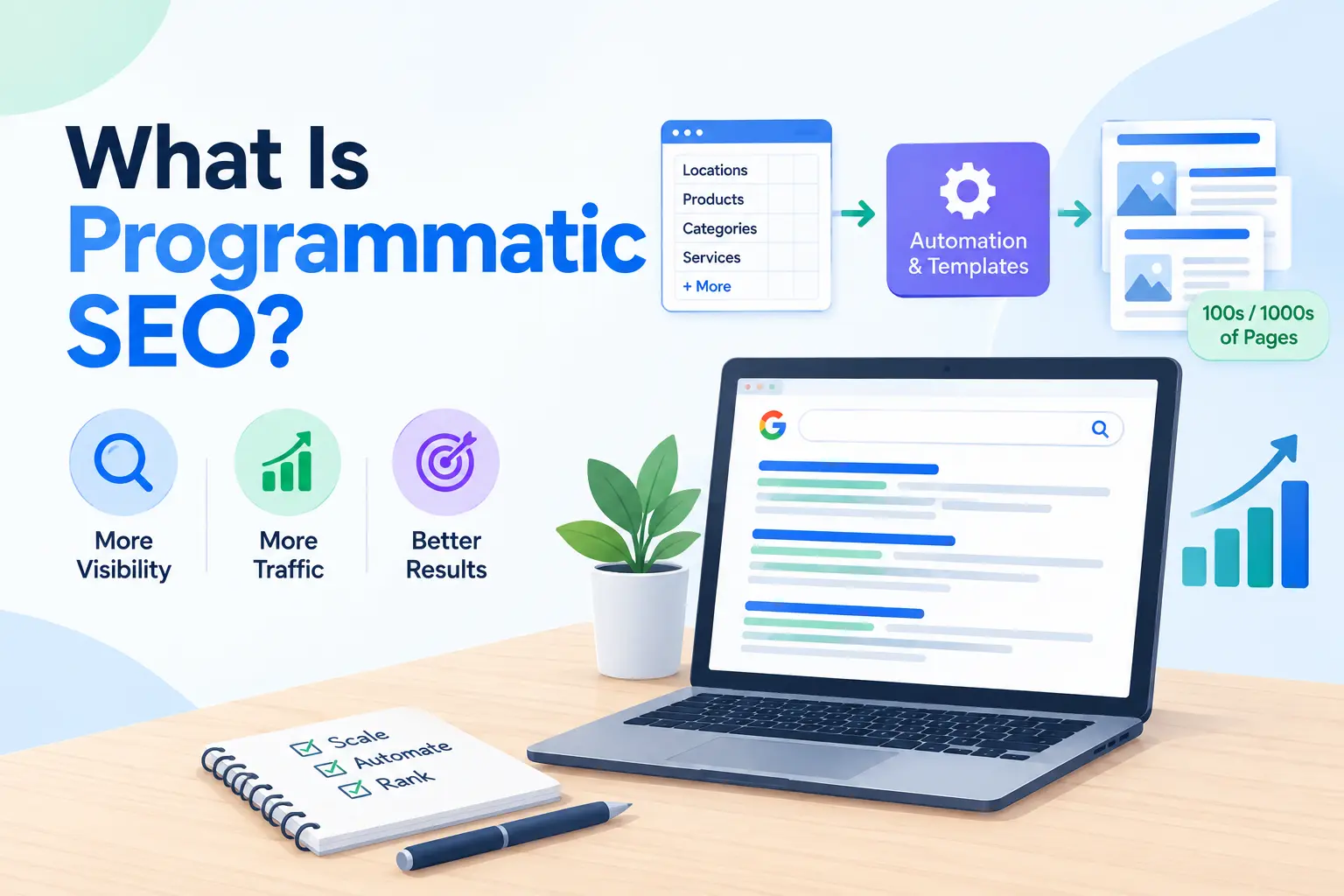
In simple terms, programmatic SEO is the practice of using templates and data to generate hundreds or thousands of search-optimized pages at scale. Wondering how programmatic SEO works or if this practice is right for your business? Stick around, and by the end of this guide, you will know everything that helps you get the most out of your SEO efforts, so your campaign gets ranked instead of being penalized.
Thinking about what is programmatic SEO? Defining the term, we would say it is the process of combining a page template with structured data to automatically create a large volume of unique, search intent-driven pages. Thus, instead of manually writing one article at a time, you build a system, and that system pulls data points such as city names, product specifications, prices, or comparison metrics, while slotting them into a pre-designed page structure.
For example, consider real estate sites that show “Homes for Sale in Dubai” for every single city in the country. Or job boards that generate a page for “Marketing Jobs in Dubai” for thousands of neighborhoods. There is one template and one dataset, but thousands of ranking opportunities.
The goal here isn’t to trick search engines, but to serve genuinely useful, specific answers to long-tail queries that would take a human content team years to cover manually.
The process typically follows four core steps:
Instead of targeting one keyword, you identify a pattern in your programmatic SEO strategy. For example, “best [product] for [use case] (e.g., “best CRM software for small businesses”) or [service] in [location]. (e.g., “plumbing services in Austin” or “marketing jobs in Dubai”). Tools that support bulk keyword export can help to uncover these repeated patterns across thousands of variations, and that’s a huge advantage for SEO professionals.
This is the backbone of the entire strategy because to proceed further, you need clean, structured data, whether that is pricing information, location data, product specs, or reviews. To build the dataset, spreadsheets, APIs, and internal databases are common sources.
A working template balances repeatability with genuine value, and it should include unique data points, helpful context, internal links, and enough distinct content per page, so search engines do not flag it as thin or duplicate.
Once the template and dataset are ready, a script or a no-code automation tool merges them to generate live pages, and based on the scale, this could mean publishing a handful of pages or tens of thousands in one go.
Seeing this in action makes the concept click faster, which is why we have compiled a table on a few well-known programmatic SEO examples:
| Template Used | Data Source |
| Home for sale in [City] | Property listings database |
| [Design Type] templates | Design category data |
| Best cities for remote work in [country] | Cost of living and climate data |
| [Software] vs [Software] comparison pages | Product review data |
| [Currency] to [Currency] Exchange Rate | Live currency data |
Did you notice a pattern here? Each example takes a single valuable question format and multiplies it across a dataset, and that is the entire magic trick.
Search engines reward pages that answer specific queries thoroughly. For these pages, long tail keywords, the kind with three or more words and lower competition, make up the vast majority of all search traffic. The most interesting part about long tail queries is that they account for a significant share of all searches that are performed daily, and most of that demand goes unaddressed by traditional content strategies. Programmatic SEO is built specifically to capture this untapped demand, and beyond traffic volume, there are several advantages of this SEO, including the following:
Both approaches aim for the same outcome — ranking well and driving organic traffic — but they get there very differently. Here’s how they stack up:
|
Factor |
Programmatic SEO |
Traditional SEO |
| Content Creation | Template + structured data, generated at scale | Manually written, one page at a time |
| Speed to Publish | Hundreds to thousands of pages in days or weeks | A handful of pages per week or month |
| Best For | Long-tail, repeatable query patterns (locations, comparisons, categories) | High-value, competitive keywords needing deep, unique insight |
| Cost Per Page | Low after initial system setup | Higher — each page requires dedicated writing/research time |
| Content Depth | Consistent but templated | Can go deeper, more nuanced per page |
| Risk of Penalties | Higher if pages lack unique value (thin content risk) | Lower, since each page is custom-built |
| Ideal Use Case | Sites with structured data at scale (marketplaces, directories, comparison tools) | Brand authority content, pillar pages, thought leadership |
| Maintenance | Requires ongoing data quality checks and template audits | Requires periodic content refreshes and updates |
The takeaway: Programmatic SEO isn’t a replacement for traditional SEO — it’s a complementary system. Most mature SEO strategies use both: traditional SEO for cornerstone content and brand authority, and programmatic SEO to capture the long tail of specific, repeatable searches your audience is already making.
Just like any other SEO strategy, there’s no all upside to this strategy. Google has cracked down repeatedly on low-quality, auto-generated pages that offer no real value. If your pages are just a template with a swapped city name and nothing else, you can expect thin content penalties or a quiet drop in rankings.
The fix here is simple in theory, but hard in practice, and it’s that: every page needs to earn its place. While generating the page, add:
That searcher cannot get anywhere else. Automation should handle the heavy lifting, not replace the value entirely.
If you are curating a programmatic SEO strategy from scratch, keep these principles close:
Our expert advice would say that programmatic SEO works best when you have access to structured, sizeable data and a clear, repeatable query pattern your audience searches for. On the other hand, it might not work if your company moves without a data advantage or in industries where every page genuinely needs bespoke, deeply researched content.
That being said, even a modest programmatic layer, say fifty to a hundred well-built pages, can meaningfully expand your organic footprint without demanding a massive content team.
Programmatic SEO isn’t a shortcut or loophole; it is a system, and like any system, it is only as good as the thought put into its design. Done right, it turns data you already have into a scalable growth engine. Done poorly, it turns into a pile of thin pages that search engines quietly bury.
The businesses winning with this approach treat every template like a product, constantly testing, refining, and adding real value page by page.
Ready to see what a well-built content and SEO system could do for your traffic? Reach out to our team at Hashtag Orange today, and we will help you map out a strategy customized to your data, your audience, and your growth goals. We would be more than happy to help you out!
Is programmatic SEO the same as automated content spinning?
No. Content spinning rewrites existing text with little added value, while programmatic SEO uses structured data and templates to create genuinely useful, unique pages at scale for specific search queries.
How many pages should I start with?
Expert SEO professionals generally start small to test template performance and indexation before scaling. This helps us to catch quality or technical issues early without risking your entire domain’s reputation.
Does programmatic SEO hurt site quality scores?
It can, if pages are thin or duplicate. With unique data points, strong internal linking, and regular quality audits, programmatic pages can actually strengthen your site’s overall topical authority.
What tools are commonly used for programmatic SEO?
Common tools include spreadsheet software, no-code automation platforms, CMS with dynamic templating, and APIs for pulling live data such as pricing, weather, or location information.
How long does it take for programmatic pages to start ranking?
Timelines vary, but many programmatic pages can start gaining traction gradually, depending on domain authority, competition, and how thoroughly each page satisfies search intent.